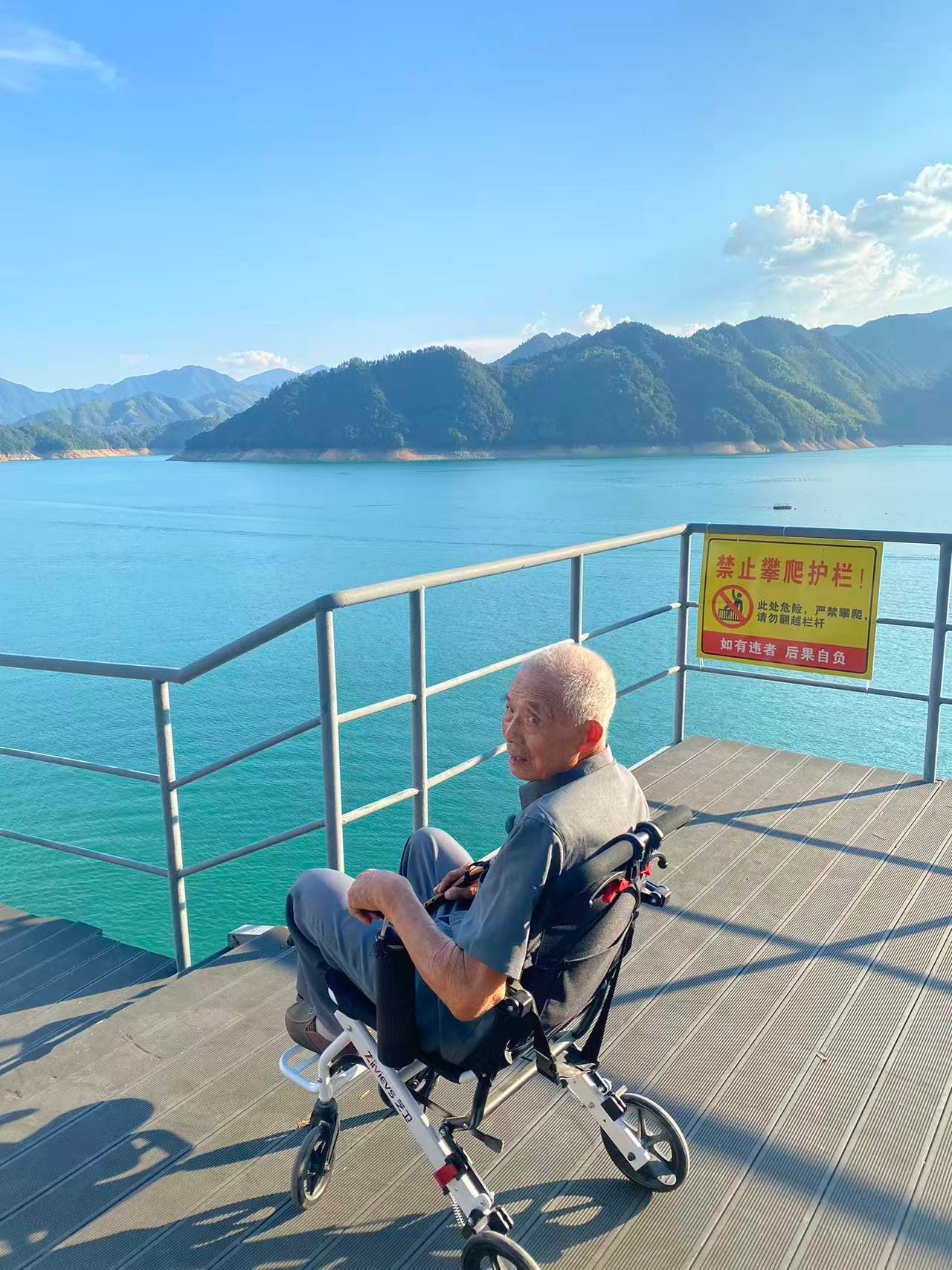
Remembering Grandpa & the War the World Forgot (Unit 731)
This is a special article commemorating the life of my grandfather, compiling research from online databases, secondary sources (news articles, family stories), and primary sources (quotes from specified people).
My grandpa is somewhat of a celebrity in his village.
Not because he won a Nobel Prize or published an artistic masterpiece, but because he is one of the oldest living victim-survivors of the deadly Second Sino-Japanese War in the 1940s that claimed his left leg.
Or, he was ... until he passed on Sunday, March 29, 2026, at 3:53 PM, Beijing time. He was 98. He'd been the oldest in the village, and now only two women of his generation remain.
All war is complicated; lives lost, families broken. But this war in particular was an anomaly for its tragic consequences, and ironically this is precisely why the suffering of those who made it out have been largely forgotten or omitted.
It was a war whose method of invasion was so unique at the time that it couldn't be assessed until decades later.
That is: germ warfare.
1920s - 1940s: The Backdrop to War
Xu Shengyu (name meaning, "produce rain") was born on June 26, 1929, in Qu County – now known as Qujiang District – in Quzhou City, Zhejiang, China. It's a landlocked city surrounded by mountains and a network of rivers, though the Zhejiang province itself reaches the coast.
He lived essentially his entire life in a rural village on the outskirts of town, called Liu Dou Yang. According to Grandpa, his own grandfather had moved from Jiangshan City to a nearby village, then from that village to Liu Dou Yang.
His grandfather's generation was so poor that they didn't even have a family altar. All honourings took place at the deceased's gravestones. For this reason, my father's side has never maintained a Xu genealogical record; they couldn't afford it. We don't know the family line beyond Jiangshan City.
My grandpa was the third son of four. In a time when production was low, and most food was sourced by rationing, his father worked and toiled with no money to cure sickness until he died in his forties. My grandpa was only around ten.
China at this time was dipping off the waves of brutal warlordism and internal strife, the Qing Dynasty (the last imperial dynasty) having just ended in 1911.

The Nationalist government, or Kuomintang (KMT), came into power in 1928, with promises of modernization and unification. The reality was that most benefits were felt in urban areas, and the poor remained poor.
During this time, the region of Manchuria in northeast China remained a vital asset for its natural resources (coal, iron ore, timber...) and availability as an industrial and military base. The Soviet Union and Japan, in particular, had been eyeing this plot of land for years, and both held special foreign privileges in the region. Between 1932-1935, Japan progressively occupied the borders of Manchuria as well.
Intent on domination, they then set their sights on the China Eastern Railway in Manchuria, successfully driving away the remaining Soviet forces administrating it (the Soviet Union sold the Railway to the Japanese puppet state of Manchukuo in 1935).
The Chinese Communist Party (CCP), led by Mao Zedong, was gradually growing its power as the opposition to the KMT. Over time, however, it became clear there was more nationalistic sentiment against Japan and foreign sovereignty than each other, and the two factions temporarily compromised in efforts to drive the Japanese out.
It was a time of unprecedented global expansion for Japan, and their gains fueled the political tension in the setup to World War II. In 1937, the Second Sino-Japanese War officially kicked off with a scuffle between Japanese and Chinese troops in the Marco Polo Bridge Incident. Some argue that 1937 was the true start of WWII.
Fast forward to 1939, and Nazi forces invaded Poland. The whole of Earth seemed to be embroiled in conflict.
The Western spotlight of the Allies vs. Axis collision has always seemed to fall on the Holocaust and the Nazi regime, and for very good reason. But to believe that China didn't play a significant role in the war of the century is an undue misunderstanding. Indeed, Allied forces provided support to China in the resistance against Japan.
An ever more dangerous misconception is that the war didn't affect Chinese citizens to the extent it did in other areas of Europe, the Americas, and Asia. China has historically been a rather insular land; perhaps that's why the tragic consequences of the Second Sino-Japanese War, feeding into WWII, fell through the cracks in history books.
This is the story of the people, who fell victim as unknowing lab rats to the atrocious experiments of germ warfare.
May 1942: The Invasion
"[Lunar Calendar] April 1942 (Gregorian Calendar: May), Japanese troops invaded my village, and my entire family fled to the mountain region of Gaolong Village. The Japanese retreated in July (Gregorian Calendar: August); soon after we returned to our hometown, blisters appeared on my left foot, then black scars, pus discharge, festers..." – Xu Shengyu
At the age of 13, the Japanese invaded Xu Shengyu's village. Zhejiang was a coveted coastal province not yet under Japanese control, and American soldiers crash-landed here after their raid on Japanese home islands in early 1942, receiving aid from Zhejiang locals. In retaliation, the Japanese purged Zhejiang and the neighbouring province of Jiangxi.
My grandpa and his family fled inland to the mountains, where they hid until the Japanese troops retreated in August that same year, having accomplished most of their tasks.

Upon returning, the villagers tilled the land and worked the fields as they always had. But soon after homecoming, something strange occurred.
People started developing "rashes" on their extremities. Red spots. Rotten spots. My grandpa saw it develop, inch by inch, on his lower left leg. In fact, many of the cases documented originated on the left leg.
Rotten.
That was the only way to describe it.
"Rotten leg syndrome" became the infamous term for a disease that would spread to an estimated 300,000: invisible, silent, and, to this day, incurable.
It was perpetuated by the gradual spreading of rotten patches of flesh that ate into the skin and drilled into the bone. There was nothing one could do about it back then. By the time the people realized this was not a coincidental occurrence, it was too late.
A secret operation in the margins of history: Unit 731
At first, there was no way of proving it, but the circumstantial evidence pointed to one likely culprit: the Japanese.
The Japanese had developed a war technique so advanced and deadly that no one could see it coming, literally.
Unit 731 was based in Harbin, China, as a testing ground and research base under the command of Shiro Ishii. Human experimentation and deployment of the bacteria formed their sources of data. The base operated from 1931 - 1945, its war crimes not limited to rape, amputation, forced frostbite, and, of course, biological and germ warfare.
There have been reported sightings of bombs dropped onto villages and into ponds before an outbreak of diseases, specifically in 1940, 1942, and 1944. My father, on hypothesizing about the source of Grandpa's disease, believes the germs were airdropped into the fields, contaminating the livestock and grains, water and clothing.