3 Most Stunning Dance Performances from the Chinese New Year Galas
Chinese New Year 2026 has officially come to an end, but every year I spend a little extra time marveling upon the latest dance creation for the annual CCTV Spring Festival Gala.
Although word on the street is that viewership has steadily declined over the years, the fact remains that the CCTV Gala is a huge deal. If you're a celebrity, actress, or performer, and you're invited to that stage, you've made it. Finito.
International artists sometimes make it on too, with artists this year including Westlife and John Legend.
But among the gaggle of comedians, long-time hosts, "Internet celebrities," and whoever is popular at the moment, one program always stands out: the principal dance piece.
There are several dances throughout the Gala, but one is always considered the "main" attraction. This is true skill here.
The dancers invited onto the Gala stage are world-class athletes. They represent not only their personal blood, sweat, and tears to have made it this far but also national pride in disseminating thousands of years of traditional Chinese dance.
My personal three favourites are, in no particular order...
Dance of the Lucky Fish《锦鲤》
In China's chase for technological progression year after year, they've found a way to do it again. My jaw dropped open when I first saw this piece in 2024. Aerial dancing with silks and wires as a fitness concept have existed for some time, but I'd never seen a dance piece executed with wires like this before.
Lead Dancer: Hua XiaoYi
Choreography: Tang ChengLong, Xu JingXian, Fan XiaoYun
Performed by: Beijing Dance Academy
Premiered at CCTV Gala: 2024
For full credits, please refer to the video.
Koi fish have long been symbols of good fortune and success. Thanks to the wires strapping them in, the dancers dip, turn, and spiral through the air without the burden of gravity. The scene looks like it came straight out of a Studio Ghibli film.
I asked the technical director of a theatre how this would've been done, and he explained accomplishing a feat like this is extremely complex. The wires are hitched to the dancers' hips and waist, so even though the dancers look effortless, they are actually engaging a huge amount of core control to keep their place, especially in the air.
He hypothesized there was probably a live controller for each of the dancers backstage to monitor the tech programming; one mistake would be all it took for the whole thing to spiral into chaos.
Watching the piece, however, you'd never think the dancers felt any restraint. They look beautiful and heavenly, the personification of actual koi fish leaping and dipping into still water.
All of this is beautifully graced by the soaring vocals of Zhou Shen (English name: Charlie Zhou), of whose song used here was his breakout recording in the music industry. "Big Fish" was originally featured in an animated film, Big Fish & Begonia, that premiered in 2016.
According to this behind-the-scenes video, "Dance of the Lucky Fish" is a representation of modern-day Chinese aesthetics: heavenly, pure, and beautiful. In October 2023, out of the twenty-nine freshmen from the Chinese Dance Division of Beijing Dance Academy, eighteen passed the preliminary audition to appear on the Gala stage. (The final performance used only 11 dancers, though the video doesn't explicitly state why.)
Traditional wire harnesses use two steel wires in special effects, but to enhance the "flow" of movement and the weightlessness of dance, the creator, Tang, requested the production team remove one wire and install a stretch band to the backside instead. While increasing range of movement, it also added tremendous risk.
It's akin to being left hanging in the air after, say, a slip from rock-climbing. There's a term in first aid called "suspension trauma" that describes the physical deterioration after prolonged suspension in the air, blood pooling in the lower body and unable to circulate. The most infamous example of this is when ten mountain climbers all died in 1972 after remaining suspended while awaiting rescue for as little as 30 minutes to 8 hours. Suspension trauma, if not treated immediately and properly, is a slow poison. The last of the climbers died 11 days after the rescue.
Unlike acrobatics and martial arts, where the limbs are free and gravity is still a defining factor, the dancers essentially had to relearn how to dance while in the air.
Tang, the creator, states in the video that upon commencing rehearsals, the hardest part was finding formation and composition. "What are you trying to convey to the audience?"
It was a painful process. Most of the dancers' movements were not up to par at first, with each individual looking like they were dancing a different choreography. The technicians had to control each dancer's wire according to temperature and individual body weight. It called for precision, which, in the trial-and-error of it all, sometimes resulted in the dancers being slammed forcefully onto the floor.
Once moved onto the Gala stage, the dancers had to recalibrate once again with the new space and different dimensions. The counts were off, the wires too high or too low. The pain of the harness digging into their bodies was real.
But, as art has a way of being, they reached a point where the piece was set, and the muscle memory took over. As Tang advised one dancer, "You must have a relationship with the [wire] band."
Song of the Dawn《晨光曲》
I admit I took a bit of liberty here. The official English name of this piece is "Dance of the Morning Light," but how could I resist the perfectly rhyming tune of "Song of the Dawn?"
Unlike the technical splendour of "Dance of the Lucky Fish," “Song of the Dawn” is all pure physical mastery.
Lead Dancer: Zhu JieJing
Choreography: Yang Fan
Performed by: Shanghai Dance Theatre
Premiered at CCTV Gala: 2020
Original dance drama world premiere: April 10, 2019.
For full credits, please refer to the video.
Zhu JieJing is no stranger to the Gala stage. Hailed as one of the most prominent Chinese dancers in the current age, Zhu has been invited multiple times for her artistry and technical prowess.
This piece is evocative of a famous Chinese "romanticism" known as 江山美人. These "Jiangshan beauties" are the literary epitome of women who embody all the traits of beauty, intellect, and decorum. Here, the piece portrays a glimpse of Shanghai women in the alleyways before dawn.
It's an elevated excerpt from a full-length dance drama called The Eternal Wave (永不消逝的电波), premiered in 2019. The original dance in the drama is called "Song of the Fishermen" (渔光曲).
The dancers are garbed in traditional Chinese qipao, and their faces are made up in the traditional style of sharp black eyebrows and pristine red lips, a gentle smile regaling their features.
This is the ideal Chinese woman from ancient times: soft, delicate, feminine; although the spirit in their eyes can't be dimmed.
Yang, the choreographer, was struck by inspiration in a cafe upon hearing melodies reminiscent of Old Shanghai.
The choreography manages to highlight all the strengths of traditional Chinese dance: synchronicity, fluidity, and imagery. Many of the poses the dancers strike are motifs from paintings past, as if the women had simply walked out of the folding screens featured in the set design.
The piece is a step away from many Gala dances in the past that catered to spectacle and splendour. In it, we see that "quiet beauty" is just as endearing, the picture of everyday simplicity.
"Song of the Dawn" is the dance I keep coming back to. It's tender in an indescribable way – flowing and ethereal, but its presence is always there, just like the women who guard and nurture in life.
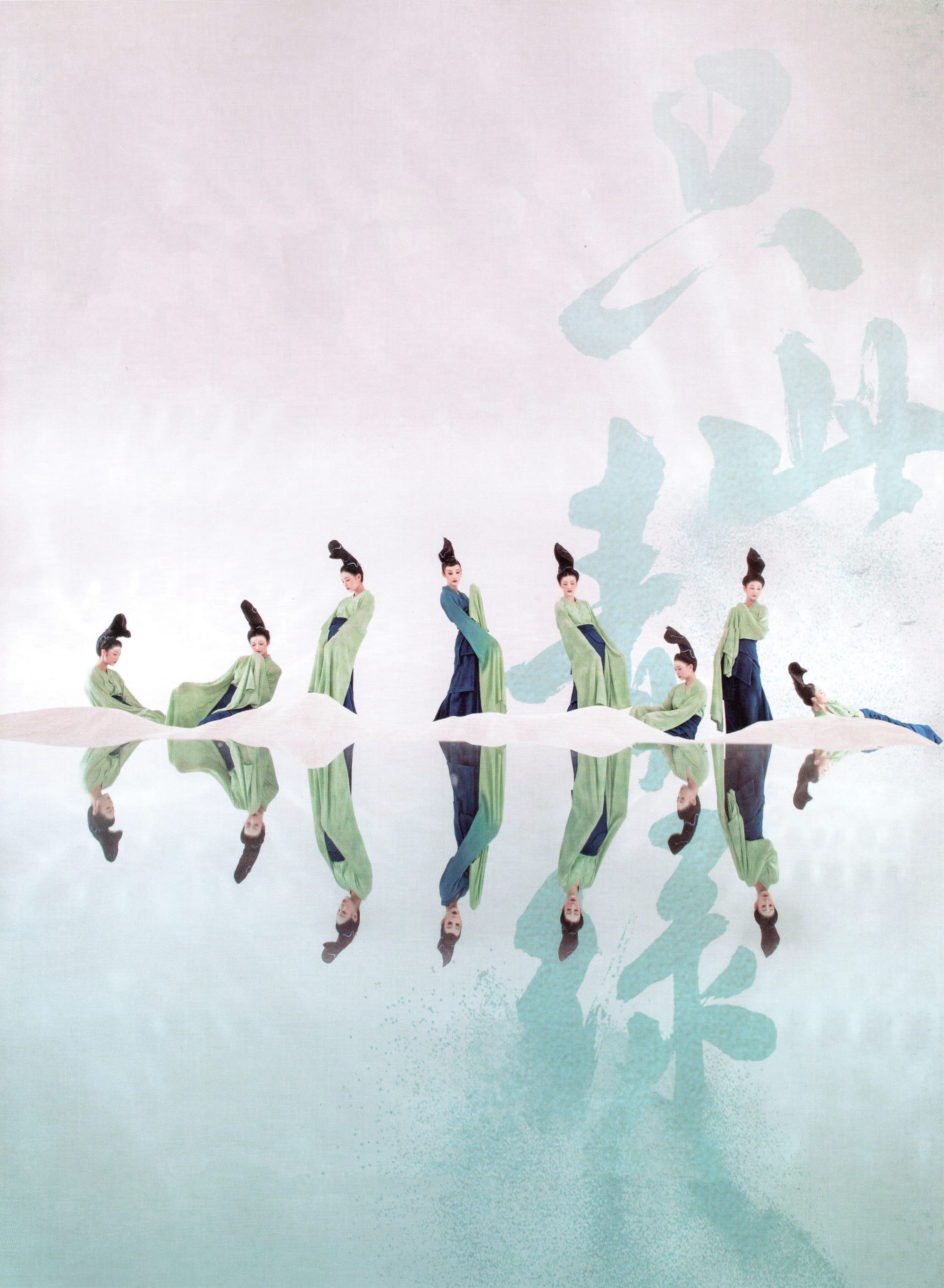
The Journey of a Legendary Landscape Painting (Excerpt) 《只此青绿》
An excerpt from a full-length dance drama named – you guessed it – The Journey of a Legendary Landscape Painting (The Journey for short) – there's never been such a viral sensation of a dance piece like this one, famous for the women's gravity-defying ninety-degree backbend.
Lead Dancer: Meng QingYang
Choreography: Han Zhen, Zhou LiYa, He JunBo, Zhang ZhenGuo, Liu Cui, Xie YuanZhen, Liu Xin
Performed by: China Oriental Song and Dance Troupe
Premiered at CCTV Gala: 2022
Original dance drama world premiere: August 20, 2021.
For full credits, please refer to the video.
It's made A-list celebrities of the lead dancers in the industry, and fans across China chase performances like one would chase a Taylor Swift concert.
The piece has inspired sponsorships and collaborations with countless brands in lifestyle products, clothing, books ... you name it. In 2024, a movie version of the full-length piece premiered in China.
It's also inspired a new interest among Chinese youth for traditional arts and heritage, having itself been inspired by the ancient painting A Panorama of Rivers and Mountains (千里江山图) from year 1113.
As a dance piece, it metaphorizes the resiliency and internal robustness of said mountains through women – majestic, proud, and ever-lasting. For Meng QingYang, lead dancer, the drama's premiere and success led up to her 30th birthday, celebrating a transition of self and deeper understanding of the world.
My full review of The Journey's North American premiere in New York City 2025, complete with background and story, will come soon!
...
Surprise! Here's a bonus dance for digestion.
Auspicious Rain《喜雨》
"Auspicious Rain" is the 2026 Gala's highlight dance celebrating fruition and the lifeline of water.
In my opinion, it's much more minimalist than previous years' dances. The monochrome costumes, the simple backdrops (but not simple tech!), and the strong use of recurring motifs in the dance work together to create a continuous, gentle tale of fresh rain in spring – ushering in the new year with a breeze and a drizzle.
Lead Dancer: Meng QingYang
Choreography: Li JiaWen, Cao DuanDan, Ai Zhu, Ai ZuoMeng
Performed by: Zhejiang Conservatory of Music (ZJCM)
Premiered at CCTV Gala: 2026
For full credits, please refer to the video.
Meng QingYang is back again leading another ensemble. Even before her international success in The Journey, Meng has been a frequent performer of Gala events since 2015, attesting to her versatility as an artist and dancer, and her continued success is marked by this invitation to perform again.
What they've done with the crystal embellishments ("rain droplets") on the hats is very clever; I can only imagine how much practice it would've taken to control the tempo and momentum of those swinging beads against inertia. The hats each weigh 5 pounds, with the dancers decked in jade hair ornaments and drop-let shaped earrings.
The minute articulation of their shoulders, hips, and feet are meant to mimic the unpredictability and trickle of rain, the image of which is prominent throughout Chinese literature. The piece is also evocative of life on boats, since boating was and is a large part of the agricultural industry in Asia. Underneath the shower lies a great romanticism.
Every year, I sit eagerly in front of the TV for the four-hour long Gala just to see the dance pieces. Every year, I am amazed at the talent of professional Chinese dancers.
As the clock counts down to midnight and the hosts announce the New Year, I reflect on the advancements that Chinese artistry has made over the years. The country has had a long history of keeping to itself; perhaps it's time to share the creativity.
Tech and AI have started infiltrating our world at alarming speeds, but what I believe will endure at the end of this trial is the beauty of live performing arts and, most significantly, a resurgence in dance – the irreplaceable art form of the body.
Now is the time for dance to shine.